
Illustrative workflow
One place. Many records. A reviewable research trail.
An illustrative workflow connecting photographs, scanned records and an interview around a single research question.
Read the workflowExplore photographs, documents, audio and video with AI-assisted discovery and source-linked review. Built around the collection you need to understand.
Pilot 1.0 · Private demonstrations
Explore your collectionImages, documents, audio and video.
Follow the sourceReturn to the supporting material.
Keep judgment humanReview context before concluding.
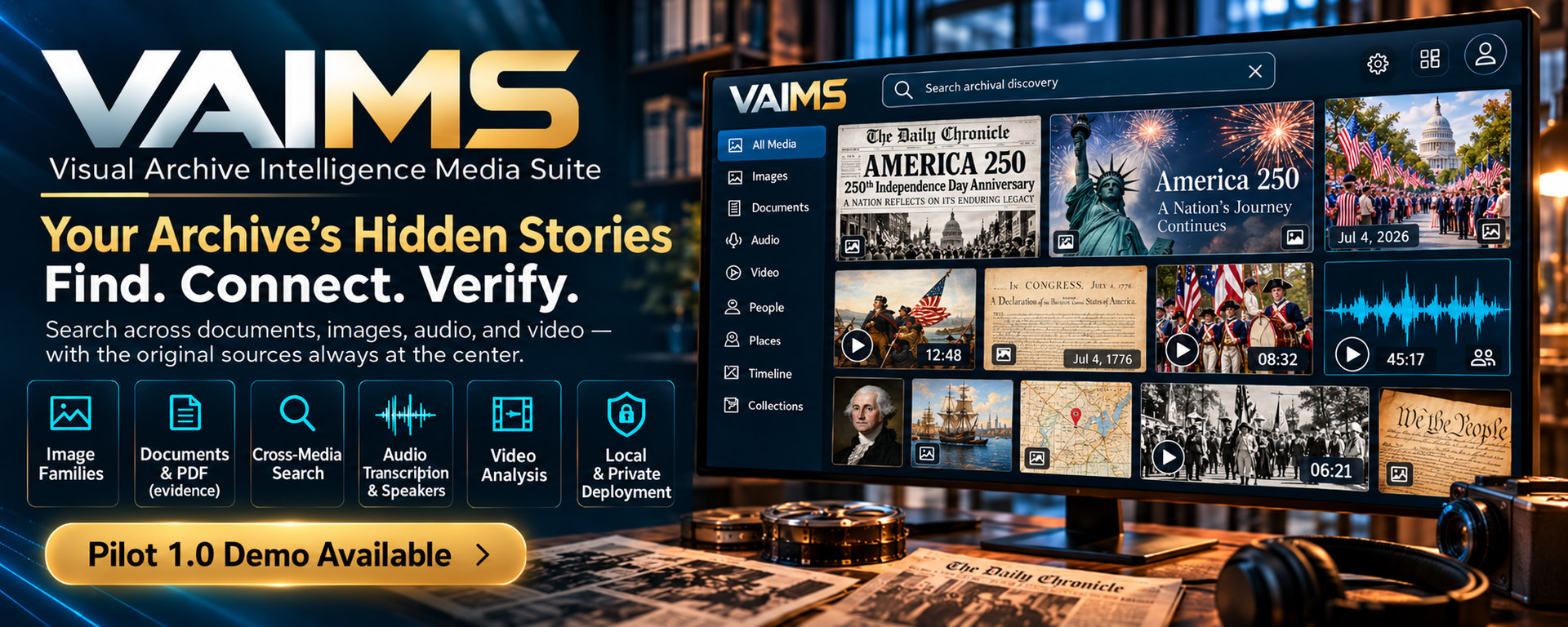
Explore images, documents, audio and video—with the original sources at the center.
Your archive might be a century old.
Or it might be yesterday’s work.
Find relevant material across records and formats.
Explore collection discovery ↗ 02 / RESEARCH & KNOWLEDGEInspect the passage, image or recording behind it.
Explore evidence review ↗ 03 / MEDIA & ORGANIZATIONSMove from hours of material to a passage you can review.
Explore recorded knowledge ↗Choose a starting point. We’ll shape the demonstration around your question.
A useful finding gives you somewhere to look next.
Follow this simple public-source example to see the difference between an image, a description and a source you can inspect.
How VAIMS approaches review ↗
A striking image is a useful starting point. Its subject, date and context need a source.
Read the original NASA source ↗
Earthrise source photograph: NASA. Educational example; no affiliation or endorsement. This is not a live VAIMS result.
An illustrative workflow connecting photographs, scanned records and an interview around a single research question.
Read the workflowAn illustrative audio and video review workflow that follows a topic from transcript search back to the original recording.
Read the workflowSee the workflow, inspect the evidence and discuss whether an evaluation fits your collection.
Request your demonstration ↗The formats, the question and any handling requirements. No archive upload is needed.
From a query to a result, then back to the source and its context.
Agree on a permitted sample, review criteria and a practical next decision.
A useful archive answer should make its supporting material easier to inspect. Here is what to ask for before you trust a polished summary.
Read the articleA focused archive demonstration starts with a real retrieval problem, an approved sample and a clear definition of a useful result.
Read the articleSimilar files can be drafts, crops, annotations or evidence of change. Review what differs before deciding what is redundant.
Read the articleHistoric records and everyday working files both hold information worth understanding. VAIMS brings discovery closer to the source—and keeps your expertise central.
Meet the project ↗Tell us about your collection and the question you need to answer.